What a conversation with Vickie Buenger revealed about the purpose of CAC2, and the strength of helping others succeed.
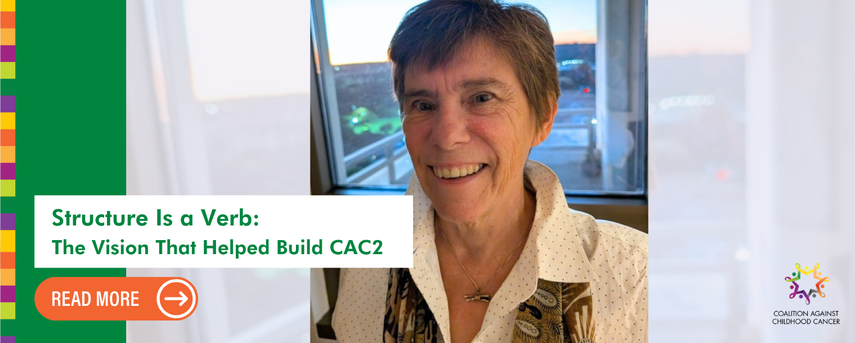
Vickie Buenger wears only two necklaces—both with significant meaning for her. One displays the coordinates of a star named in honor of her daughter, Erin. The other is a small bundle of sticks.
One evokes a deep, personal connection. The other symbolizes a personal belief that helped shape the Coalition Against Childhood Cancer (CAC2).
I learned about both in May 2026, when I reached out to Vickie to understand CAC2’s origins. I expected a history lesson. What I received is something I’ve been thinking about ever since.
The Strength of a Bundle of Sticks
Vickie is an organizational scholar who spent decades studying and teaching how organizations and teams function. She also helped bring CAC2 together, drawing on both that professional understanding and her experience as a mother whose family was affected by childhood cancer.
Her explanation of the bundle was simple. A single stick can break. Bound together, sticks become much harder to break.
That captures CAC2’s founding purpose: helping the individuals and organizations working in childhood cancer accomplish more by working together. Each member brings its own mission, expertise, network, and community. The goal isn’t to make members identical or to ask them to give up their independence.
It’s to help them succeed in creating a world without childhood cancers.
CAC2 exists to connect people, share knowledge, encourage collaboration, and create opportunities for members to advance their collective missions. We are the helpers. The coalition’s strength lies less in what CAC2 accomplishes than in what our members can accomplish because they are connected.
Remembering and Forgetting
“Structure is a verb,” Vickie told me.
“Structure” suggests something permanent and unchanging, but “structuring” implies a continuous process. Building an organization is not the same as sustaining the relationships and shared purpose that give it meaning.
This observation relates to something else she told me about remembering and forgetting. Organizations need to remember their history, their lessons, and the reasons they came together. They must also recognize that things work until they stop working. Forgetting, in this sense, doesn’t mean erasing history. It means cultivating a willingness to let go of assumptions and practices that no longer serve the purpose.
The needs of children and families change. Research advances. Organizations grow, and new advocates bring different experiences and ideas. What helped members collaborate in the past may evolve to meet their needs in the future.
Honoring a founding vision doesn’t require preserving every decision made along the way. Sometimes honoring that vision means changing how we pursue it.
Discovering the People Behind the Coalition
As I began working on CAC2’s communications, I started learning more about the people serving alongside me on its Board. I knew they were accomplished. I hadn’t fully appreciated the range of experience that brought them together.
Some have spent years supporting families facing childhood cancer. Others have connected families, clinicians, and researchers around deeply personal and complex decisions. Some bring expertise in engineering, organizational leadership, and program management. Others have dedicated their careers to research, philanthropy, international advocacy, and pediatric drug development.
And the Board is only a small reflection of the knowledge across CAC2’s membership. Behind every member organization are people who have built programs, funded research, supported families, advanced policy, and learned lessons that could help someone else.
I had approached this work thinking about how to tell CAC2’s story. I came to realize that the more important task is helping its members tell theirs, especially the stories of what they accomplish together.
Helping Without Becoming the Center of the Story
One example of this philosophy in practice is CAC2’s Childhood Cancer Hub, which brings together the Hope Portal and Better Together survivorship resources. The Hub helps families and survivors discover information, support, and services offered by organizations across the childhood cancer community.
Families shouldn’t have to understand the nonprofit landscape to find help. And individual organizations shouldn’t have to provide every possible service to be valuable. CAC2’s role is to connect those needs with the organizations and resources that can address them. Each organization keeps its own identity and mission; the shared resource makes its work easier to find.
To me, that’s Vickie’s bundle of sticks in practice. A coalition doesn’t have to be the center of every success story to have helped make that success possible.
The Work Is Never Finished
I went to Vickie to understand how CAC2 began. I came away with a clearer understanding of why it exists.
One of the pieces she wears honors Erin. The other reminds us that our strength comes from what we can accomplish together. Vickie helped bring that vision to life. Our responsibility is to keep making it possible for members to help one another succeed.
Structure is a verb. And the work is never finished.
Has a connection through CAC2 helped your organization solve a problem, find a partner or reach a family?
We’d like to hear about it: Staff@cac2.org
Explore the Childhood Cancer Hub: https://childhoodcancerhub.anddit.com/
