Home » Survivorship Toolkit » Genetics Information

Genetics Information

By Jennifer Ivanovich (MS LCGC), Genetic Counselor

INTRODUCTION

Did you ever ask if your child’s cancer could be “genetic”? Have you considered if your family cancer history could be related to your child’s diagnosis of cancer, even though the cancer diagnoses were not the same type? Did you question how genetic testing may be helpful for your child? Did you discuss if your other children or other family members could have a higher chance to develop cancer? If your child had genetic testing, have you considered if updated information may be informative for your child’s care or the care of other family members?  

If you asked yourself these and similar questions, you were considering the possibility your child has an inherited cancer syndrome. This section describes information about genetics – information about our inherited genetic make-up as well as tumor genetics. The primary focus is on inherited genetics with information pertaining to inherited cancer predisposition syndromes and how this information is used to guide a child’s care, both during cancer treatments and survivorship, and potentially the care of other family members.


BASIC INFORMATION – GENES AND CANCER

Every person has over 20,000 genes in every cell of the body. Our genes, or DNA, not only determine what we look like, such as our eye color or texture of our hair. Our genes determine how cells function within the body. For example, our genes determine that colon cells have a different structure and function than our brain cells. Our genes also control how cells grow and divide.

A cancer or tumor develops when cells have lost their ability to stop making new cells.

For most children, cancer develops sporadically. That is, a single cell spontaneously develops a gene mutation.  Over time, as this cell makes more cells, additional gene mutations occur, but only in those cells. If these cells accumulate a sufficient number or type of gene mutations, the cells lose their ability to stop growing, forming a cancer.

In contrast, children with an inherited cancer predisposition syndrome have a gene mutation that was present from the time the child was conceived. That gene mutation is present in all the cells. Certain gene mutations lead to a higher chance for certain cancers to develop, and sometimes, these tumors develop in childhood. This factsheet reviews general information about gene mutations that are associated with an increased chance for cancer, that is gene mutations that cause cancer predisposition syndromes.


INHERITED CANCER PREDISPOSITION SYNDROMES

Every person has gene mutations. Mutations, also known as pathogenic variants, disrupt a gene’s normal, everyday function. Mutations do not allow the gene to function properly. Some mutations are not important for a person’s overall health and wellbeing. Consider for example a person with a gene mutation that only causes premature grey hair. While that person may not like grey hair at a younger age, it is not an important health consideration. Other mutations, do matter, like mutations which cause an increased risk for certain types of cancer. 

An inherited cancer predisposition syndrome result from a gene mutation found in a person’s inherited genetic make-up, or DNA. Some people may use the term, hereditary cancer. Individuals with an inherited cancer predisposition syndrome have an increased risk for certain types of cancer. Having a gene mutation associated with higher cancer risk does not mean a person will ever develop a cancer. However, it does mean they have a higher chance for certain cancers compared to people of the same age and gender, and as such, additional cancer screening and medical care would be recommended for that individual.

Having an inherited cancer predisposition syndrome typically does not mean your child has a higher chance of experiencing a recurrence of their cancer. The chance that a child’s tumor will recur is often based on other factors, such as the size and grade of the tumor, and if the child had lymph node involvement with their cancer.

Why would a family want to know if they had an inherited cancer predisposition syndrome? Knowing if a child has an inherited syndrome may help to guide treatment as well as ongoing medical surveillance. Likewise, in some situations, there is scientific evidence that demonstrate certain gene mutations make treatments less effective.


FAMILY EXAMPLE

Consider an 8-year-old child who has a pheochromocytoma located in both adrenal glands. The adrenal gland sits on top of the kidney and they produce a variety of essential hormones. The child is found to have an inherited mutation, or what is called germline mutation, in the VHL gene. Every person has two copies of the VHL gene. It serves a normal role in the cell. VHL gene mutations lead to a condition known as von Hippel Lindau (VHL) syndrome, an inherited cancer predisposition syndrome. Individuals with von Hippel Lindau syndrome have an increased chance to develop tumors in the eye, brain and spine, known as hemangioblastomas, as well as tumors in the pancreas, kidney and adrenal glands. Identifying that the child has this condition is essential in the most appropriate ongoing surveillance, following treatment for their pheochromocytomas. Furthermore, the VHL syndrome is one of the inherited conditions in which there is an available targeted therapy, known as belzutifan, that has been developed based on the specific role of the VHL protein. The inherited genetic information guided decisions regarding how best to follow the child, as well as provided information that is instrumental in guiding therapy decisions.

Considering this child’s family, it would be helpful to know, is this child the first in the family with this gene mutation or does one of the child’s parents has the same VHL gene mutation? Individuals who are the first in the family with the mutation are considered to have a de novo, or new mutation. If one of the child’s parents has the mutation, that information is critical in guiding that parent’s medical care and informing the care of the parent’s other children, siblings and extended relatives.  

A great deal of medical literature quotes 5 – 10% of all cancers have an inherited genetic contribution. In general, this statement is a considerable oversimplification! The likelihood that a child diagnosed with cancer has an inherited cancer predisposition syndrome is dependent on several factors, such as:

  • Cancer type,
  • Age at diagnosis,
  • Family history of cancer,
  • Personal history of more than one cancer type,
  • Cancer found in paired organs, for example – retinoblastoma in both eyes
  • Personal history of other health features such as size at birth, head size, or certain skin findings, such as café-au-lait spots, and,
  • Personal history of other health issues, such as birth defects or learning concerns.

Let’s consider a few examples, taking into consideration only the tumor type. Nearly 30-40% of all children with SHH type-medulloblastoma have an identifiable inherited genetic mutation in one of several genes. Children with choroid plexus carcinoma (CPC) have a similar likelihood of having a mutation, while young women with Sertoli Leydig cell tumors of the ovary have over a 60% chance to have a gene mutation. In contrast, acute lymphocytic leukemia, a common childhood cancer, is believed to have a much lower likelihood of an inherited predisposition. These data also demonstrate that even if a family has no family history of cancer, it is still possible the child has an inherited cancer predisposition syndrome.

Genetic testing is used for a variety of purposes, including testing a tumor to help identify therapy, as well as genetic testing for inherited cancer predisposition syndromes. Let’s examine different types of genetic tests and what information can be learned from these analyses.

GENETIC TESTING

There are many different types of genetic tests, including for example, chromosome analysis, multi-gene panels, or even whole genome sequencing. Each test has benefits and limitations, and provides different pieces of information.

We encourage you to consider the results of genetic testing as one piece of information, among many pieces of medical information, that is used to help guide your child’s medical care.

Let’s consider different types of genetic testing.

Somatic / tumor analysis

Somatic or tumor genomic analysis examines the genetic architecture of a tumor. All tumors have genetic abnormalities or mutations. These mutations caused these specific cells to lose their ability to stop making new cells – and form a cancer. Testing is performed on a biopsy of the tumor or from a blood sample where circulating tumor cells can be analyzed.

The primary goal of tumor genomic analysis is to identify targeted therapies based on the specific genetic characteristics of a given tumor. Some people refer to this type of analysis as Precision Cancer Genomics. Consider 10 children, all 9 years of age, diagnosed with an embryonal rhabdomyosarcoma, a type of sarcoma. Tumor or somatic analysis is designed to identify the genetic abnormalities, which are similar and different among these ten tumors, even though they are all classified as embryonal rhabdomyosarcomas. The care team will capitalize on these differences, when possible, to guide therapy decisions.

In addition, tumor / somatic genomic analysis may be used for diagnostic purposes. In some cases, the standard pathology tests that are currently available cannot always definitively determine the specific cancer type. Tumor genomic analysis may be used to help identify the specific cancer diagnosis so appropriate therapies may be initiated.

The types of tests performed on tumors vary widely and provide different pieces of information. Here are some common tests that are used.

Some Genetic Tests Used for Somatic / Tumor Analysis

Name

Multi-gene panels

Exome analysis

Gene fusion panel

Immunohistochemistry

(IHC) analysis

Chromosome Analysis

Description

Sequencing and deletion / duplication analysis is performed. The number of genes analyzed depends on the specific tests.

Exons are the coding sequence of our genetic material. The exome is the total exons found throughout our genome. Exons are examined for the presence of a sequencing mutation.

Panel used to look for specific gene fusions. Gene fusions results when the DNA structure between two independent genes is rearranged to form a new hybrid gene that promotes cells to grow abnormally.

IHC analysis examines for the presence or absence or specific proteins in the tumor. The choice of which IHC analysis to perform is determined by the specific type of tumor 


Chromosome analysis is used to assess if the total number of chromosomes are present, are there missing pieces of chromosome, or have some of the chromosomes abnormally attached to one another.


Example

A Wilms’s tumor with a WT1 gene mutation, p.R233W

An adrenocortical carcinoma identified with a TP53 gene mutation, p.R175H

Ewing sarcoma with the EWSR1-FLI1 gene fusion (a gene fusion that results from a specific translocation between chromosomes 11 and 22

IHC analysis to assess for the presence of the DNA-mismatch repair proteins, MLH1, MSH2, MSH6 and PMS2

Acute myeloid leukemia with a chromosome translocation involving chromosome 8 and 21

Although tumor analysis is not designed to detect germline / inherited genetic mutations, the tumor analysis may provide important clues for the possibility of an inherited mutation. We discuss inherited genetic testing next. 


Germline / Inherited genetic testing

Germline or inherited genetic testing is used to examine a person’s inherited genetic make-up, or inherited DNA. Testing is performed using a sample of blood, saliva, buccal (cheek) swab, or skin biopsy sample. Although each person has over 20,000 genes, currently most germline genetic testing is performed using multi-gene panel – several genes are analyzed at one time. The number of genes analyzed depends on several factors, including the child’s specific cancer diagnosis, the extended family cancer history, the family’s desire for information, and the ordering provider’s genetic testing preferences.

Genetic Testing Example

Consider two children both diagnosed with different types of sarcomas. One child, age 12, is diagnosed with an osteosarcoma (a type of sarcoma) of the upper leg. A multi-gene test, which analyzes 25 genes associated with risk for osteosarcoma, and other cancer types, would be one appropriate test option to consider. Another child is diagnosed at 1 year of age a with pleuropulmonary blastoma (PPB), a type of lung sarcoma. Analyzing only one gene, the DICER1 gene, would appropriate as the DICER1 gene is the only gene to date identified as causing risk for pleuropulmonary blastoma, and other cancer types.

There are many different types of genetic tests used to examine a person’s inherited DNA. Many of the same types of tested used to analyze a tumor are also used to evaluate changes in our inherited genetic make-up, including multi-gene panels, exome, genome and chromosome analysis. Ask the ordering provider some of the benefits and limitations of the testing that was ordered. For example, some inherited genetic testing does not examine for large deletions or duplications, a type of mutation. Chromosome analysis is used to examine the structure and number for chromosomes and is not used to sequence any specific gene. Imprinting analysis is used to evaluate if certain genes are turned off and lead to a specific diagnosis, such as Beckwith Wiedemann syndrome, an overgrowth syndrome associated with early childhood cancer risk.


Inherited genetic testing results

Families are inundated with multiple types of pathology, radiology, and laboratory results. The results of germline / inherited genetic testing are different than the typical laboratory results families of children with cancer typically follow throughout the course of treatment and follow-up.

Keep in mind that genetic testing is a descriptive test. Consider how inherited genetic testing is performed. DNA, or genetic material, is extracted from a blood, saliva, or skin sample. Most often, two different types of tests are performed on the DNA. One analysis, known as gene sequencing, examines many of the “letters” which make the DNA instructions. A second, different type of analysis is used to check for large deletions or duplications in the DNA. The results of these analyses are compared to a “reference” sequence, or what is currently considered to be the typical set of instructions that comprise the gene.

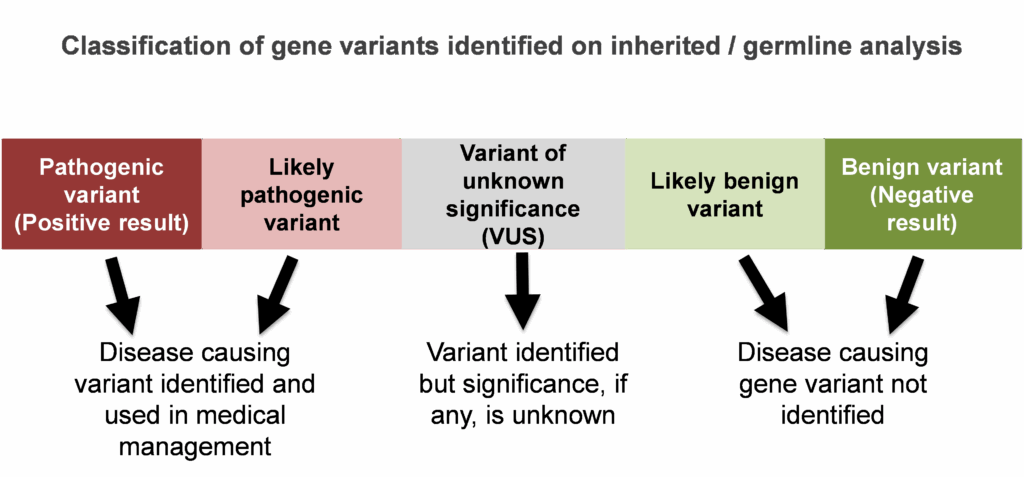
Gene variants, or variants in the DNA sequence, are categorized into one of five categories, and each category has different meanings. Most gene variants do not disrupt gene function and are simply naturally occurring differences among people. Below is a list of categories and the meanings of the variant categories. 

  • Pathogenic variants, also referred to as gene mutations – gene variations which disrupt how that specific gene functions, and are associated with an increased cancer risk.
  • Variant, likely pathogenic – gene variants for which there is growing evidence the gene variant disrupts the gene function, and leads to an increased cancer risk.
  • Variants of unknown significance (VUS) – a gene variant which cannot be distinguished as either pathogenic or benign, based on the current data. The clinical significance of this type of gene variant, if any, is unknown. As such, this information is typically not used in planning a person’s care.
  • Variant, likely benign – gene variants for which there is growing evidence the gene variant does not disrupt the gene function, and is not associated with an increased cancer risk.
  • Benign variants, also known as polymorphisms, do not disrupt how the gene functions and are not associated with increased cancer risk. Polymorphisms are naturally occurring differences among people. Laboratories typically do not report benign variants identified on genetic testing.


See the diagram below for the different results from genetic testing.

Updated inherited genetics information

Although the human genome has been sequenced, the function of most of the 20,000 genes has yet to be identified. As our genetic knowledge grows, your child’s care team may revisit the type of genetic testing that was previously performed for your child and consider if additional testing would be helpful. For example, a small percentage of children with neuroblastoma are believed to have an inherited gene mutation. Some children diagnosed with neuroblastoma, who do not have a history of a birth defect or learning concerns, have had genetic testing for two genes, the ALK and PHOX2B genes. Inherited mutations in these two genes cause risk for neuroblastoma. In a recent study published in 2023, it was identified that mutations in the SMARCA4 gene also causes risk for neuroblastoma (PubMed number: 36813544). This association has only recently been uncovered and will alter the genes that are analyzed for children with neuroblastoma moving forward.

The Molecular Characterization Initiative (MCI), sponsored by the COG, is conducting both tumor and germline analysis for children with brain tumors, sarcomas and rare tumors. This initiative is helping to pave the way so that eventually all children diagnosed with cancer will have both tumor and germline analysis performed soon after diagnosis.

LOGISTICS and COSTS OF INHERITED GENETIC TESTING

Inherited genetic testing is performed using a blood, saliva, buccal (cheek) swab, or skin biopsy sample. A skin biopsy sample is obtained for children who have received a donor stem cell transplant. Genetic testing typically should not be performed for 10-14 days following a blood transfusion, even if a saliva sample is obtained.

The sample is shipped to a commercial laboratory and the child’s health insurance is billed to perform the testing. Results are typically available within 2-3 weeks following initiation of the testing.

Due to market competition among the commercial laboratories, the cost of genetic testing for families has dropped substantially over the past few years. Now, out-of-pocket costs for inherited genetic testing, even analysis of multiple genes, is most often below $250!

If a child is found to have an inherited gene mutation, then other family members may consider genetic testing. When possible, testing for both parents is recommended to determine if their child has an inherited gene mutation, or determine if the child is the first in the family with the gene mutation. If a parent has the mutation, then their other children and extended family members may also have this mutation. Changes in the medical care of family members with the mutation would be recommended.

You will always want to keep a copy of any genetic testing report, whether it was inherited gene testing or tumor genetic testing. The report will document the specific technology that is used and the specific genes analyzed. Having a copy of your child’s genetic testing report will help to answer the question, should updated genetic testing be considered, as genetics knowledge advances over time.


KNOW YOUR FAMILY MEDICAL HISTORY

Your family story is an incredible story that is always unfolding. And, your family medical history is part of your family’s amazing story.

The family medical history is one piece of information that is helpful in guiding your child’s ongoing surveillance, and the care of other family members, including parents, are essential in assessing the likelihood of an inherited cancer predisposition syndrome.

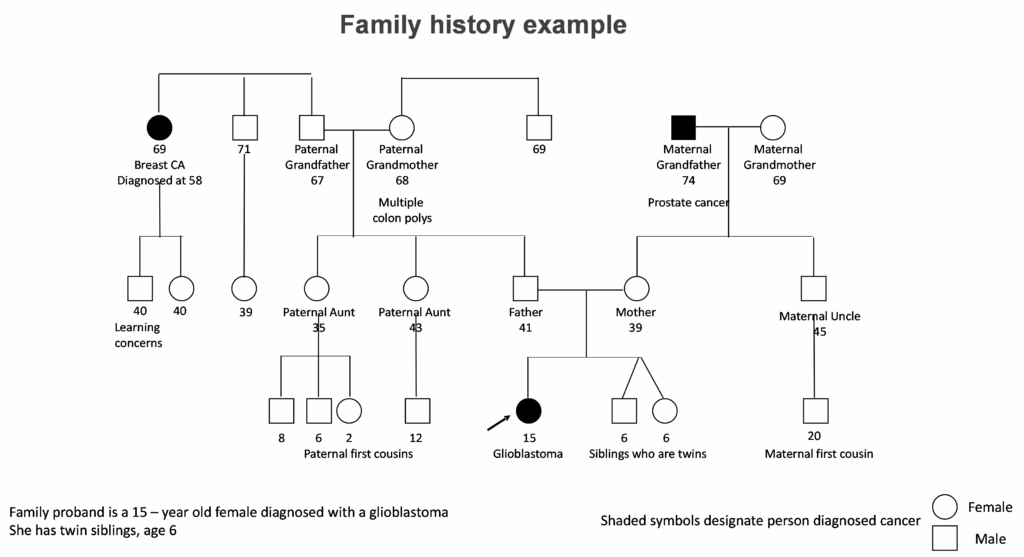
In the clinic, we use a structure called a pedigree to document the family medical history. Documenting the family history using a pedigree structure allows your healthcare team to quickly see the size of the family, the number of close relatives to your child, and to assess for patterns of cancers or other health conditions in the family.

A family pedigree is drawn using circles and squares, with females identified using circles and males are designated with squares. A proband (designated with an arrow) is the person who is being seen for assessment and family members are designated based on how they are biologically related to the proband. Children are shown one level below their parents while siblings are shown on the same level.

Family cancer information

Using a pedigree structure is just one way to document your family medical history. No matter what approach works best for you, we encourage you to document your family medical history. When considering your family cancer history, here are some important questions to ask regarding family members who have been diagnosed with cancer:

  • What was the specific cancer type?
  • Did their cancer start in that part of the body or spread from somewhere else?
  • About what age was that family member diagnosed?
  • Did the family member with cancer have more than one primary cancer (two different cancer types)
  • Did the family member with cancer have any exposure that may have increased their cancer risk?
  • Did your family with cancer have somatic / tumor analysis performed? If so, would they be willing to share a copy of the results for your child’s care team to review?
  • Did anyone in your family have inherited genetic testing, regardless if they were diagnosed with cancer? If so, would they be willing to share a copy of their results for your child’s care team to review?
  • Are there close family members who were born with a birth defect, such as missing bone, or close family members with learning concerns or autism?


RESOURCES

  1. National Society of Genetic Counselors (NSGC): https://nsgc.org

Professional society for genetic counselors. Find a genetic counselor who care for families with children who have been diagnosed with cancer.  

  1. Centers for Disease Control and Prevention – Family history tool: https://cbiit.github.io/FHH/html/index.html

Create a secure, online family health history.

  1. Genetic Information Nondiscrimination Act (GINA): https://www.hhs.gov/hipaa/for-professionals/special-topics/genetic-information/index.html

Information from the US Department of Health and Human Services regarding the genetic information nondiscrimination act (GINA).

SURVEILLANCE RECOMMENDATIONS, UPDATED IN 2024

In 2017, a group of articles, focused on surveillance recommendations for children with germline (inherited) gene mutations associated with cancer risk, were published in the journal Clinical Cancer Research. This is the journal for the American Association for Cancer Research (AACR). Given we don’t have decades of research to know what are the “best” screening guidelines for each gene, clinical experts from diverse fields collaborated to derive these guidelines. In 2024, the surveillance guidelines were updated and over time future updates will be made to these recommendations. Below are the references for the most recent publications.


  1. Brzezinski et al. Update on Surveillance Guidelines In Emerging Wilms Tumor Predisposition Syndromes. 2024. Clinical Cancer Research. Online ahead of print publication. PMID: 39466169.


  1. Kalish et al. Update on Surveillance for Wilms Tumor And Hepatoblastoma In Beckwith-Wiedemann Syndrome And Other Predisposition Syndromes. Clinical Cancer Research. 2024 Dec 2;30(23):5260-5269. PMID: 39320341.


  1. Kamihara et al. Neuroblastoma Predisposition and Surveillance-An Update from the 2023 AACR Childhood Cancer Predisposition Workshop. 2024. Clinical Cancer Research Aug 1;30(15):3137. PMID: 38860978.


  1. Hansford et al. Update on Cancer Predisposition Syndromes and Surveillance Guidelines for Childhood Brain Tumors. 2024. Clinical Cancer Research. Jun 3;30(11):2342-2350. PMID: 38573059.


  1. Maese et al. Update on Recommendations for Surveillance for Children with Predisposition to Hematopoietic Malignancy. 2024. Clinical Cancer Research. Oct 1;30(19):4286-4295. PMID: 39078402.


  1. Das et al. Clinical Updates and Surveillance Recommendations for DNA Replication Repair Deficiency Syndromes in Children and Young Adults. 2024. Clinical Cancer Research. Aug 15;30(16):3378-3387. PMID: 38860976.


  1. Nakano et al. Update on Recommendations for Cancer Screening and Surveillance in Children with Genomic Instability Disorders. 2024. Clinical Cancer Research. Nov 15;30(22):5009-5020. PMID: 39264246.


  1. MacFarland et al. Pediatric Cancer Screening in Hereditary Gastrointestinal Cancer Risk Syndromes: An Update from the AACR Childhood Cancer Predisposition Working Group. 2024. Clinical Cancer Research. Oct 15;30(20):4566-4571. PMID: 39190470.


  1. Schultz et al. Update on Pediatric Surveillance Recommendations for PTEN Hamartoma Tumor Syndrome, DICER1-Related Tumor Predisposition, and Tuberous Sclerosis Complex. 2024. Clinical Cancer Research. PMID: 39540884.


  1. Schultz et al. DICER1-Related Tumor Predisposition: Identification of At-risk Individuals and Recommended Surveillance Strategies. 2024. Clinical Cancer Research. PMID: 39400264.


  1. Perrino et al. Update on Pediatric Cancer Surveillance Recommendations for Patients with Neurofibromatosis Type 1, Noonan Syndrome, CBL Syndrome, Costello Syndrome, and Related RASopathies. 2024. Clinical Cancer Research. Nov 1;30(21):4834-4843. PMID: 39196581.


  1. Michaeli et al. Update on Cancer Screening In Children With Syndromes of Bone Lesions, Hereditary Leiomyoma And Renal Cell Carcinoma Syndrome, and Other Rare Syndromes. 2024. Clinical Cancer Research. PMID: 39601780.


  1. Greer et al. Update on Whole-Body MRI Surveillance for Pediatric Cancer Predisposition Syndromes. 2024. Clinical Cancer Research. Nov 15;30(22):5021-5033. PMID: 39287924.

Jennifer Ivanovich (MS LCGC), Genetic Counselor

Indiana University,
Associate Professor of Clinical Medical & Molecular Genetics
Licensed Certified Genetic Counselor