Key Takeaways
- Kentucky’s model is replicable. The state created its Pediatric Cancer Research Trust Fund in 2015 and has committed more than $50.5 million since the first appropriation in 2018. Liz Turner says the legislation has been used as a template elsewhere.
- The appropriation is the ask, not the check-off. Kentucky’s voluntary tax check-off has raised $123,831 in nine years. The legislature supplied essentially everything else. The one state that has copied Kentucky so far copied the check-off.
- Funding a program does not mean reaching every family. Gilda’s Club Louisville runs roughly 190 free programs a month, nearly all within eight miles of Louisville. The families at the center of Kentucky’s DIPG cluster are three hours east.
- You cannot fund what you cannot count. Kentucky has no reliable count of children in the state living with DIPG, because families cross state lines for treatment and registries do not talk to one another.
- Two CAC2 members are inside this story. Liz Turner and Karen Morrison are both featured in independent reporting, and one of them is asking this coalition for help.
Ten Eastern Kentucky children have been diagnosed with DIPG in two years. The entire state typically sees two to three cases a year. DIPG has almost no survivors. As of the end of July, the CDC has joined the state’s investigation.
Journalist Shay McAlister has spent months reporting on the families inside that number. Her latest piece asks what Kentucky is getting right in response, and two CAC2 members are at the center of the answer.
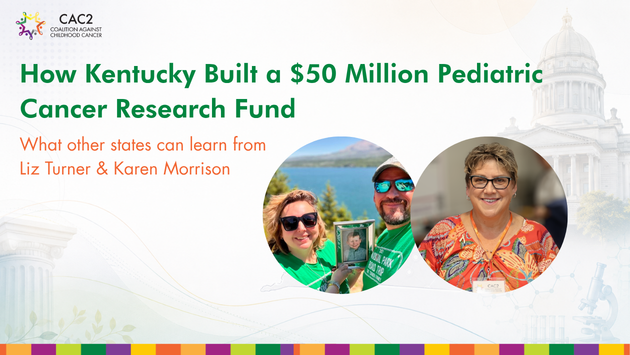
Liz Turner, CAC2’s 2026 Volunteer of the Year, is president of the board of the Kentucky Pediatric Cancer Research Trust Fund, the state entity now directing more than $50 million toward pediatric cancer research. Karen Morrison, president and CEO of Gilda’s Club Louisville, is delivering direct financial support to families the week a diagnosis is confirmed.
We could stop there and simply congratulate them (and both deserve it!), but that would waste what this story actually offers: three things the rest of this coalition can use.
1. How Kentucky’s pediatric cancer research fund works, and why other states are copying it
Kentucky created its Pediatric Cancer Research Trust Fund in 2015. Since the first appropriation of $5 million in 2018, the state has committed more than $50.5 million across successive budget cycles. In fiscal 2025 alone the board funded 45 research projects totaling $10,732,808. More than $9.6 million has been committed to DIPG and pediatric brain and central nervous system tumor research since July 2024.
The number is impressive, but the transferability is even more important. Liz says Kentucky’s legislation was used to build California’s in 2025, and that other states are modeling their own on it.
Most states have nothing comparable. The American Childhood Cancer Organization counts eight states with dedicated pediatric cancer research appropriations as of 2025, together exceeding $119 million. Kentucky’s is among the largest and longest-running, and it has survived multiple budget cycles and proven it can be replicated.
For members working state policy, the document worth studying is not this article. It is Kentucky’s enabling statute and the structure of the fund it created. How the board is constituted. How grants are awarded. How the appropriation was defended year over year. Those are the questions a legislator in another state will ask.

Why the check-off is not the ask
Kentucky has a voluntary tax check-off box for the fund. In nine years, it has raised $123,831, under $14,000 annually and declining. Essentially all of the real money came from the legislature.
Look at what actually crossed state lines. California’s 2025 childhood cancer legislation is AB 703, which created the California Pediatric Cancer Research Voluntary Tax Contribution Fund. It is a check-off. Taxpayers may designate an amount above their tax liability on their return.
A check-off is easier to pass. It carries no appropriation, it asks nothing of the general fund, and it tends to move on consent calendars.
An appropriation is harder, and that’s where the money is.
If you are carrying Kentucky’s model into your own statehouse, carry both halves. The check-off builds a constituency and a line item people can see. The appropriation is what funds the science.
Liz came to this work after her son David was diagnosed with DIPG in 2018 at age six. He died three years later. In Shay McAlister’s article, Liz explains that it will never be enough until a diagnosis comes with a treatment plan that leads to survivorship. Pride in the work and impatience with its pace are not in tension, and most people reading this hold both.
2. What happens when a member organization runs out of reach?
Karen Morrison has led Gilda’s Club Louisville for nearly twenty years. Her organization runs about 190 free programs a month, and through a trust fund grant now provides pediatric families a $500 unrestricted check on confirmed diagnosis. Since the program doubled its allotment on July 1, Gilda’s Club has served 67 families and spent 89% of the budgeted amount.
Nearly all of that programming sits within eight miles of Louisville. The families at the center of this cluster are three hours east.
Karen is direct about the ceiling. Reaching rural Kentucky means partnerships with hospitals in places like Corbin, Mount Sterling, and Paducah, and resources her organization does not currently have. She says in the article that there are children in Eastern Kentucky her organization is not reaching—that she needs help figuring it out, and that it is bigger than her team.
That is a member of this coalition asking the coalition for something.
This is the part that does not happen without a coalition. Karen can name the gap in a news article and hope. Inside CAC2, she can name it to 545 members across 40 states, some of whom have solved exactly this problem: rural reach at distance, hospital partnerships, virtual programming that actually works.
If you are a member organization operating in Eastern Kentucky or Appalachia, or if you have built rural outreach that functions across a three-hour radius, Karen wants to hear from you. Email connect@cac2.org and we will connect you with her.
This is also a Hope Portal question. Families three hours from the nearest support organization are exactly who the Portal exists to reach.
3. Why Kentucky can’t count its own DIPG cases
Both women, interviewed separately and without being led there, raised the same obstacle.
Kentucky cannot reliably say how many children in the state are living with DIPG. Families cross state lines for treatment, so cases scatter across registries that do not talk to one another. Karen has heard a figure as high as 44 statewide, heard rather than confirmed. Liz hits the same wall from the research side, which is why the trust fund is financing shared genomic and clinical databases alongside the science itself.
You cannot study a pattern you cannot count. You cannot fund what you cannot describe. You cannot find families you do not know exist.
That is the argument for National Childhood Cancer Registry participation, made more persuasively by two people living inside the problem than by any policy brief we could write. The NCCR is a component of NCI’s Childhood Cancer Data Initiative and is the first resource linking childhood, adolescent, and young adult cancer records across population-based registries. It is also, precisely, the work CAC2 members are doing on registry participation and data infrastructure.
Kentucky is what the absence of that infrastructure looks like from the ground: a confirmed cluster, a state genuinely trying to respond, and no reliable denominator to respond against.
What a childhood cancer coalition actually does for its members
A coalition earns its existence by turning one member’s experience into something every member can use. Liz’s fund is a template for state advocates in more than forty other states. Karen’s gap is a request that only a network can answer. The counting problem both women describe is the case for a policy position CAC2 already holds, now with two people testifying to it from inside a live crisis.
None of that happens on its own. Someone has to read the story, recognize what is portable in it, and put it in front of the people who can use it. That is the work.
If your organization is doing something that other members could learn from, or if you are stuck on something another member may have already solved, tell us. This is what the coalition is for, and it only works if we hear about it. Stories like this one are a reminder that a challenge one member is working through is often a solution another member may have to offer. We’ve set up connect@cac2.org for exactly that reason—and we hope you’ll use it.
Don’t forget to read the original article
Shay McAlister has kept this one outside her paywall deliberately. It is worth reading in full, particularly the sections on the research itself: a University of Louisville CAR-T program engineered for DIPG that cleared tumors in most treated animals, and a University of Kentucky lab building zebrafish “avatar” models to predict how a specific child’s tumor might respond before treatment begins.
What Kentucky is getting right: Inside the state’s fight against childhood cancer, Shay McAlister, Shay Informed, August 4, 2026.
Congratulations to Liz, and to Karen and her team. And thank you to Shay McAlister for reporting that treats these families and this disease with the seriousness they deserve.
Frequently Asked Questions About State Pediatric Cancer Research Funding
What is a state pediatric cancer research trust fund?
A state pediatric cancer research trust fund is a dedicated funding mechanism, created by state legislation, that directs recurring public appropriations toward childhood cancer research conducted within that state. A governing board typically reviews and awards grants to research institutions. Unlike federal grants or private philanthropy, the money is state-appropriated and renewed through the legislature’s regular budget cycle, which makes it both durable and politically contestable. Kentucky’s version, established in 2015 by Senate Bill 82, has become one of the most frequently copied.
How much has Kentucky committed to pediatric cancer research?
More than $50.5 million since the first legislative appropriation of $5 million in 2018. The Kentucky Pediatric Cancer Research Trust Fund was created in 2015 by Senate Bill 82. In fiscal 2025 the board funded 45 research projects totaling $10,732,808.
Does a tax check-off box raise meaningful money for pediatric cancer research?
Kentucky’s experience suggests not on its own. The state’s voluntary check-off has raised $123,831 across nine years, an average under $14,000 annually and declining, against more than $50.5 million appropriated by the legislature over the same period. California’s 2025 pediatric cancer legislation also established a voluntary check-off rather than an appropriation.
Why is it difficult to count childhood cancer cases at the state level?
Families frequently cross state lines for specialized treatment, so a single child’s case may be recorded in a registry other than their home state’s. Without shared data infrastructure like the National Childhood Cancer Registry, no state can produce a reliable count, which makes it harder to identify clusters, fund research proportionally, or locate families who need support.
What is DIPG?
Diffuse intrinsic pontine glioma is a rare and almost universally fatal pediatric brain tumor that forms in the brainstem. It primarily affects children between the ages of 5 and 10, with median survival under one year from diagnosis. Roughly 200 to 300 children in the United States are diagnosed each year.